

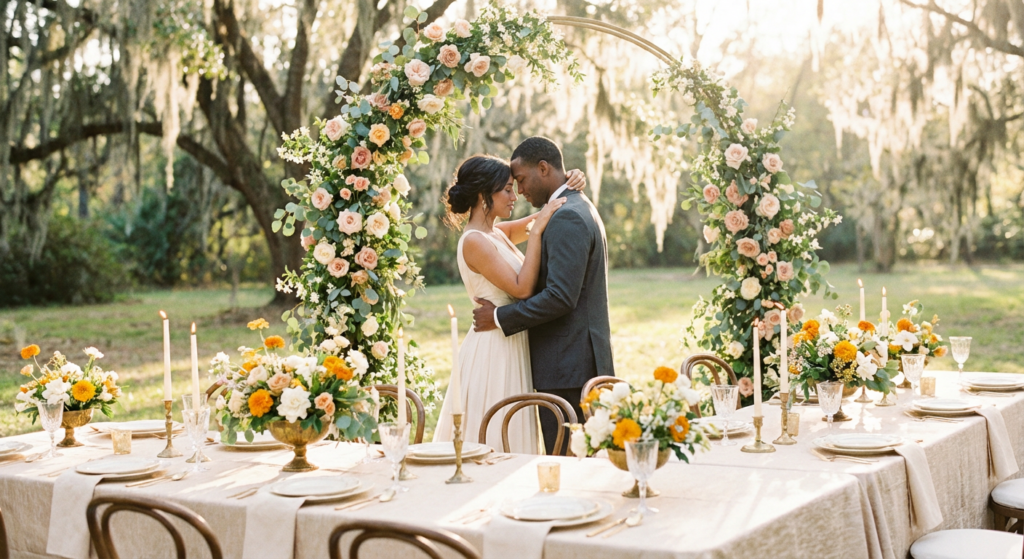
Mira and James wanted 40 guests, two ceremonies, and zero compromises—and their intimate wedding planning journey proved that smaller celebrations can honor bigger stories.
The couple, both physicians relocating from Chicago to Atlanta, needed a planner who could execute a dual-ceremony celebration that honored Mira’s Hindu heritage and James’s Southern Baptist roots. With limited time to visit vendors and no local connections in Newnan, they required end-to-end coordination that respected both cultural traditions without diluting either one.
Why Intimate Weddings Require Strategic Planning
Intimate doesn’t mean simple. When guest counts drop below 50, every detail becomes magnified. Each conversation matters. Every vendor interaction is visible. The ceremony structure carries more weight because there’s nowhere to hide logistical gaps.
For multicultural couples, intimate wedding planning introduces additional layers:
- Coordinating multiple ceremony formats within a single timeline
- Sourcing vendors who understand cultural protocols and religious requirements
- Managing family expectations across different celebration traditions
- Designing spatial flow that accommodates distinct ritual needs
- Communicating vendor requirements in advance to prevent day-of confusion
Mira and James needed a planner who understood that their 40-person celebration required the same systems-driven approach as a 200-guest event—just with higher stakes for personalization.
The Planning Process: Two Ceremonies, One Cohesive Vision
Belle Leroux began with a comprehensive discovery session that mapped both ceremony requirements, family dynamics, and non-negotiable cultural elements. The goal: create a seamless day that transitioned between a morning Hindu ceremony and an afternoon Christian ceremony without forcing guests to choose or families to feel secondary.
Vendor Vetting With Cultural Competency
The couple’s biggest fear was hiring vendors who would nod politely but fail to execute cultural details correctly. We prioritized:
- Officiant coordination: Secured a Hindu priest familiar with abbreviated ceremony formats and a Baptist minister comfortable with interfaith celebrations
- Catering with intention: Vetted caterers experienced in vegetarian Indian cuisine and traditional Southern reception fare, ensuring cross-contamination protocols for dietary restrictions
- Photography and videography: Selected a team that understood the significance of specific ritual moments (saptapadi, ring warming) and could anticipate key shots without intrusive direction
- Floral design: Worked with a designer who sourced marigolds for the mandap and integrated them into the reception aesthetic rather than treating them as separate décor elements
Every vendor received a detailed run-of-show with cultural context, timing requirements, and photography priorities before the contract was signed.
Intimate Wedding Planning in Newnan: Logistics That Scale Down
Smaller guest counts don’t reduce complexity—they redistribute it. Here’s what changed:
Venue selection shifted from capacity to flexibility. We needed a space that could transform between ceremonies without requiring guests to relocate. The chosen venue offered an outdoor ceremony site and an adjacent covered pavilion, allowing for mandap setup and breakdown during a planned cocktail hour.
Invitations required precision. With 40 guests, every RSVP mattered for seating, catering counts, and ceremony participation. We implemented a digital RSVP system with meal preference tracking and ceremony attendance confirmation to eliminate last-minute guesswork.
Timeline compression demanded tighter vendor coordination. The mandap installation happened at 7 a.m. Ceremony one began at 10 a.m. Breakdown and transition occurred during an 11:30 a.m. cocktail hour. Ceremony two started at 1 p.m. Reception followed at 2 p.m. Every vendor had a 15-minute buffer built into their contract timeline.
Guest experience became hyper-personalized. Handwritten welcome notes. Customized ceremony programs explaining both traditions. A lounge setup that encouraged conversation rather than filling space. Favors that reflected both cultures instead of generic tokens.
What This Couple Learned About Intimate Wedding Planning
Mira and James shared three insights after their celebration:
- Cultural integration requires advance education. Providing guests with a program that explained each ceremony element reduced confusion and increased engagement. Family members felt included rather than observant.
- Vendor communication prevents day-of surprises. Because every vendor received detailed cultural briefings and timeline expectations upfront, there were no moments of hesitation or improvisation during rituals.
- Intimate celebrations amplify planner value. With fewer guests, the planner’s role shifts from crowd management to experience curation. Every transition, every vendor handoff, every family dynamic becomes a planned touchpoint rather than a reactive moment.
The ROI of Professional Intimate Wedding Planning
For working professionals planning from out of state, the value equation isn’t about cost savings—it’s about time reclamation and confidence.
Mira and James made two site visits to Georgia during their engagement. Everything else happened through video calls, shared planning boards, and our vendor coordination. They didn’t spend weekends researching caterers or calling florists. They didn’t second-guess whether their priest would arrive on time or if the mandap would meet their expectations.
They showed up on their wedding day knowing the systems were in place, the cultural details were handled, and their families would experience a celebration that honored both of them equally.
When Intimate Means Intentional
The smallest weddings often carry the biggest emotional weight. When you’re planning a multicultural celebration with limited local knowledge and demanding professional schedules, intimate wedding planning becomes less about decoration and more about operational excellence wrapped in cultural respect.
Ready to plan an intimate celebration that honors your heritage without compromising your timeline? Start your planning process here and let’s build a wedding day that reflects both of your stories.
FAQ
How far in advance should we book a planner for an intimate wedding?
We recommend booking 8-12 months before your wedding date for intimate celebrations. Smaller guest counts don’t reduce planning complexity—they increase the need for vendor precision and cultural coordination. This timeline allows for thorough vendor vetting, custom timeline development, and detailed communication that prevents day-of surprises.
Can a wedding planner handle multiple cultural ceremonies in one day?
Yes, with the right systems and cultural competency. Successful multicultural intimate wedding planning requires advance vendor education, detailed run-of-show documentation, and built-in timeline buffers between ceremonies. The planner should coordinate with religious officiants, understand ritual requirements, and communicate cultural protocols to every vendor before contracts are signed.
What’s the difference between a coordinator and a planner for intimate weddings?
A coordinator executes your existing plan in the final weeks before your wedding. A planner builds the entire strategy from vendor selection through day-of execution. For intimate multicultural celebrations, full-service planning ensures cultural details are integrated from the beginning rather than adapted at the end—especially critical when planning from out of state or managing dual-ceremony formats.