

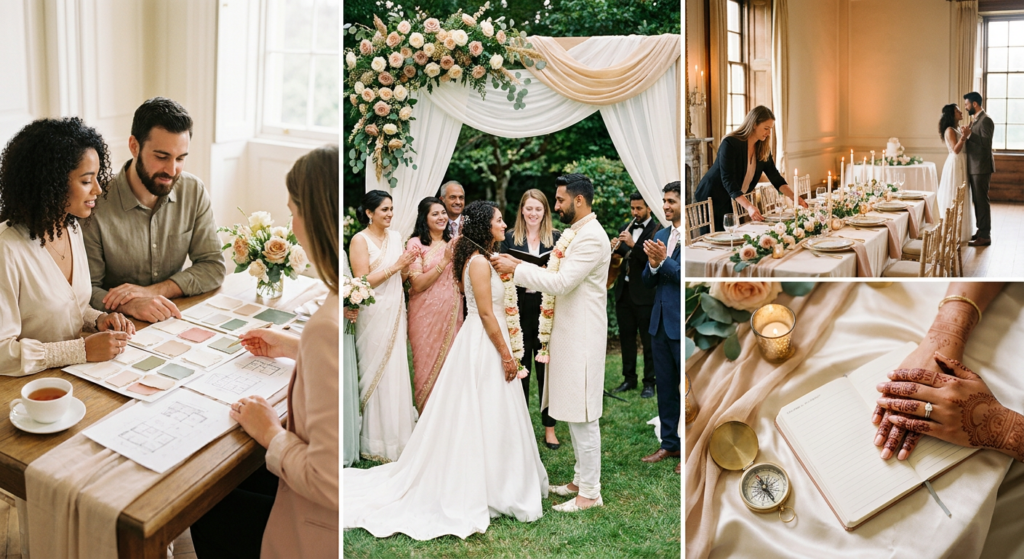
Choosing between a full-service planner and a day-of coordinator isn’t just about timeline—it’s about who carries the weight of your wedding from the moment you say yes to the moment you say “I do.”
For couples planning an intimate celebration, the stakes feel even higher. Every detail matters more when your guest count is intentional, your venue is personal, and your vision includes cultural traditions that deserve to be honored with precision. Understanding the difference between intimate wedding planning services can mean the difference between a celebration that unfolds seamlessly and one where you’re troubleshooting vendor miscommunications three weeks before your ceremony.
What Full-Service Intimate Wedding Planning Actually Includes
Full-service planning begins the day you book and extends through your final sendoff. This comprehensive approach means your planner becomes the architect of your entire wedding experience, not just the execution team on your reception day.
Core responsibilities include:
- Venue research, site visits, and contract negotiation
- Complete vendor sourcing, vetting, and coordination
- Budget development and tracking across all categories
- Design conceptualization that honors cultural elements
- Timeline creation for engagement period through wedding day
- RSVP management and guest communication support
- Ceremony and reception logistics planning
- Rehearsal coordination and family processional guidance
- Day-of execution with full vendor management
For couples in Newnan or planning from out of state, this model removes the burden of vendor research entirely. Your planner handles the complexity of coordinating florists who understand mandap design, caterers experienced with fusion menus, and photographers who know how to capture both your first look and your baraat entrance.
The Day-Of Coordinator Model: What It Covers (And What It Doesn’t)
Day-of coordination—sometimes called “month-of” coordination—typically begins 4-6 weeks before your wedding date. The coordinator steps in after you’ve already booked your venue, selected your vendors, finalized your design, and managed your own planning process.
Standard day-of services include:
- Final vendor confirmation calls
- Timeline creation based on contracts you’ve already signed
- Rehearsal walk-through
- Wedding day vendor management
- Setup oversight and troubleshooting
- Ceremony and reception coordination
- Emergency kit and backup planning
What day-of coordination doesn’t include: the months of decision-making that precede it. You’re responsible for finding vendors who understand your cultural requirements, negotiating contracts without industry knowledge, and ensuring every element of your vision translates into actionable vendor instructions.
For working professionals with physician schedules or attorney caseloads, this model still requires significant time investment during your engagement—precisely when you have the least bandwidth to spare.
Intimate Wedding Planning in Newnan: Why Scale Matters
Intimate weddings—typically defined as celebrations with 50 guests or fewer—require a different planning approach than large-scale events. The assumption that smaller guest counts mean simpler logistics doesn’t hold up in practice.
Intimate celebrations often involve:
- Boutique venues with limited vendor access or strict guidelines
- Highly personalized elements that require custom sourcing
- Multi-day celebrations or extended family gatherings
- Cultural ceremonies with specific timing and spatial requirements
- Higher per-guest investment in experience and design
When your ceremony includes both a traditional Christian service and a Hindu saptapadi, or your reception features both a seated dinner and a hora, the coordination complexity doesn’t decrease with guest count—it intensifies. Belle Leroux specializes in intimate wedding planning that addresses this reality, building systems that honor cultural nuance while managing the operational details that make or break execution.
Cost Structure: Investment Comparison
Full-service planning typically represents 12-15% of your overall wedding investment, while day-of coordination ranges from $1,500 to $3,500 as a flat fee.
The cost difference reflects scope, not just hours worked. Full-service planning includes vendor relationship leverage that often results in better pricing, contract terms that protect you from hidden fees, and design efficiency that prevents costly mistakes during the decision-making process.
For couples planning from Colorado or other out-of-state locations, the value equation shifts further. The alternative to full-service planning isn’t just hiring a day-of coordinator—it’s managing long-distance vendor communication, scheduling site visits around work travel, and navigating unfamiliar vendor markets without local expertise.
When Day-Of Coordination Makes Sense
Day-of coordination serves couples well in specific scenarios:
- You have significant event planning experience or industry connections
- Your wedding vision is straightforward with minimal cultural integration
- You genuinely enjoy the research and decision-making process
- You have local family members who can assist with vendor meetings
- Your work schedule allows for consistent planning time over 12-18 months
If you’re planning a ceremony at a full-service venue with in-house catering and limited outside vendor needs, a coordinator can execute what you’ve already built.
When Full-Service Planning Becomes Essential
Full-service planning shifts from helpful to essential when:
- You’re planning from out of state without local venue knowledge
- Your celebration incorporates multiple cultural traditions or ceremonies
- Your professional schedule makes vendor vetting nearly impossible
- You need a planner who understands specific cultural vendor requirements
- You want a single point of contact who owns the entire process
- Your venue requires extensive outside vendor coordination
For multicultural couples, the planning complexity multiplies. Finding a caterer who can execute both Southern comfort food and authentic Indian cuisine, coordinating timing for both a church ceremony and a mehndi celebration, ensuring your photographer understands the significance of your arras ceremony—these aren’t tasks you want to manage via evening phone calls after a 12-hour work shift.
The Hidden Timeline Factor
The most underestimated difference between these models is when stress occurs. With day-of coordination, you carry planning stress throughout your entire engagement. With full-service planning, you transfer that weight to a professional who manages it systematically.
For dual-income couples with high-demand careers, the engagement period shouldn’t require project management skills on top of your existing responsibilities. Full-service planning means responsive communication when you need it, proactive problem-solving before issues escalate, and confidence that someone with systems expertise is handling the operational complexity.
Making the Decision for Your Celebration
Start by auditing your actual capacity—not your aspirational capacity. Consider your work travel schedule, your partner’s availability, and your realistic evening and weekend bandwidth over the next 12-18 months.
Then evaluate your wedding’s operational complexity: venue requirements, cultural elements, vendor coordination needs, and guest logistics. Match your capacity against your complexity, and the right model becomes clear.
Frequently Asked Questions
Can I start with day-of coordination and upgrade to full-service planning later?
Most planners require full-service clients to book at least 8-12 months before the wedding date to provide comprehensive support. Upgrading mid-planning is possible but limits the planner’s ability to influence vendor selection, negotiate contracts, or course-correct early decisions. If you’re uncertain about your capacity, booking full-service planning from the start provides flexibility to step back when work demands increase.
How do I know if a planner has experience with my cultural traditions?
Review their portfolio for weddings that incorporated your specific cultural elements—not just multicultural weddings generally. Ask direct questions about their experience coordinating ceremonies like yours, their vendor relationships within your cultural community, and how they approach learning traditions they haven’t previously coordinated. Experienced planners will have specific examples and established vendor networks.
What happens if I hire a day-of coordinator but realize I need more help?
Some coordinators offer partial planning packages that bridge the gap between day-of and full-service. However, these typically still begin months into your engagement, after you’ve made foundational decisions about venue and major vendors. If you’re already feeling overwhelmed, adding planning support earlier rather than later prevents costly mistakes and preserves your engagement experience.
Let’s Build Your Celebration With Intention
Your intimate wedding deserves a planning approach that matches its significance. Whether you’re coordinating cultural traditions, managing logistics from out of state, or simply protecting your time during your engagement, the right planning support makes all the difference.
Ready to explore how full-service planning can transform your wedding experience? Start the conversation today and discover what’s possible when someone else carries the complexity.